
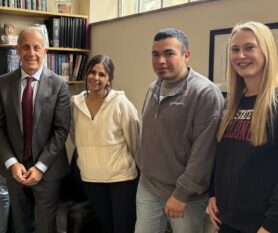
Law students in the NIU College of Law Prisoners’ Rights Project scored a significant victory in federal litigation this April. The student-lawyers, who operate with a 711 license, successfully settled a case for $200,000 in which they alleged that their client “John Doe” was subjected to torture and other abusive treatment by federal corrections officers.
The lawsuit claimed that the clinic’s client was beaten by officers at the U.S. penitentiary in Thompson, Illinois, that he was kept in four-point restraints for seventeen hours in a “torture room,” and that he was falsely described as a child molester by the officers in order to encourage other inmates to physically and sexually assault him.
The clinic’s student-lawyers and its director, Professor Marc Falkoff, partnered on the litigation with attorneys Richard Dvorak and Liza Vasilyeva of Dvorak Law Offices, a prominent civil rights law firm. Over the last two academic years, the clinic students engaged in extensive legal research in support of their client and assisted in critical motion practice.
Pursuant to the settlement, the federal Bureau of Prisons did not concede that its employees engaged in any misconduct, but the substantial award will meaningfully assist John Doe, who was recently released from confinement.
The “special management unit” at Thompson where the alleged torture occurred became the subject of oversight hearings by the U.S. Senate’s Judiciary Committee, led by Senator Dick Durbin (D-IL). The unit was shuttered by the Bureau of Prisons in 2023.
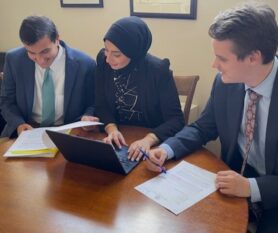 The NIU Law Prisoners’ Rights Project was established in 2019 with the assistance and support of the P. Michael Mahoney chapter of the Federal Bar Association. Attorney Dvorak previously served as the clinic’s supervising attorney for several years. Since the clinic’s inception, student-lawyers have represented nearly two-dozen prisoners who alleged that their constitutional rights were violated by prison employees. Law students with a 711 license are allowed to practice law while supervised by a licensed attorney, pursuant to Illinois Supreme Court Rule 711.
